
Industry, Estuaries, and the Next Frontier: Why the Humber Region is Leading the Net Gain Revolution
Why the Humber Region is Leading the Net Gain Revolution
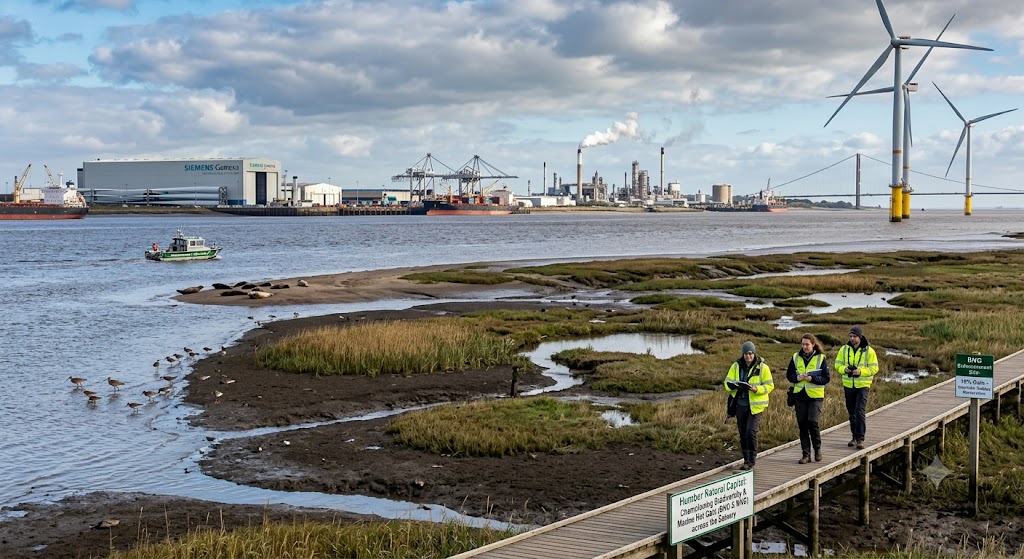
##Industry, Estuaries, and the Next Frontier: Why the Humber Region is Leading the Net Gain Revolution
The Humber region has long been defined by its unique duality. On one hand, it is a vital economic engine—a massive hub for ports, offshore wind infrastructure, hydrogen production, and carbon capture. On the other, it boasts one of the UK’s most important natural ecosystems, with the Humber Estuary designated as an internationally significant Ramsar site supporting a vast array of wildlife and intertidal habitats.
As we navigate the expanding landscape of mandatory environmental targets in 2026, Humber Natural Capital is uniquely positioned to help developers bridge the gap between industrial ambition and ecological restoration. With the government’s recent confirmation that mandatory 10% Biodiversity Net Gain (BNG) is expanding to include Nationally Significant Infrastructure Projects (NSIPs) later this year, the stakes for regional infrastructure developments have never been higher.
But standard terrestrial BNG is just the beginning. The Humber is also perfectly placed to capitalise on the next major regulatory evolution: Marine Net Gain (MNG).
##Debunking BNG: Moving From Myths to Strategic Reality
Navigating BNG can feel like a maze for developers, but understanding the legislative reality prevents costly planning delays and missteps. Let’s dispel a few common misconceptions:
- Myth: BNG is a temporary political trend that will soon be rolled back.
Truth: BNG is firmly anchored in both primary and secondary legislation. Any substantial changes would require comprehensive legislative amendments preceded by a formal public consultation.
- Myth: Developers can easily clear a site before an assessment to lower their baseline requirements.
Truth: Local Planning Authorities (LPAs) have strict statutory powers to combat deliberate site degradation. If degradation is suspected, the LPA can force a development to re-baseline using its historical habitat condition dating back to January 2020.
- Myth: You can simply buy the cheapest offsite units from anywhere across the country without penalty.
Truth: While developers can legally purchase offsite units from anywhere in England, the statutory metric heavily penalises out-of-area units using a Spatial Risk Multiplier. Sourcing units far from the development site drastically reduces their value, meaning you have to buy significantly more units to meet your target.
To avoid the “nightmare scenario” of overpaying or securing the wrong units entirely, early integration into your project pipeline is essential. Incorporating nature-friendly features like Sustainable Urban Drainage Systems (SuDS), green roofs, or rain gardens into the initial design stage directly counts toward your net gain. Furthermore, retaining and enhancing existing habitats generates far more biodiversity units than clearing land and starting from scratch, allowing you to bypass severe replacement ratios—such as needing to replace a single cut-down tree with up to 30 new ones.
The Financial Reality: BNG Unit Pricing in England (North)
To give developers a clearer picture of market expectations, the June 2025 Biodiversity Units UK Pricing Report provides a detailed regional benchmark for unit costs inclusive of legal and transaction fees. Because the Humber sits within the Northern tracking boundary, local market averages indicate the following baseline rates:
| Habitat Type | Habitat Distinctiveness | Average Price (Per Unit) | Regional Supply Level |
|---|---|---|---|
| Other Neutral Grassland | Medium | £25,449 | Abundant |
| Woodland and Forest | Medium | £34,887 | Medium |
| Open Mosaic Habitat (OMH) | High | £71,750 | Scarce |
| Watercourses - River (Priority Habitat) | Very High | £205,000 | Scarce |
Critical Market Insight: Demand for watercourse units continues to rise sharply across England while supply remains extremely limited. Developers unable to source local watercourse units are regularly forced to purchase from out-of-area suppliers, frequently incurring a punishing 2x Spatial Risk Multiplier. Sourcing localized habitat solutions is vital to protecting your project’s bottom line.
The Intertidal Advantage and the Shift to Marine Net Gain (MNG)
As a coastal and estuarine region, the Humber operates under unique environmental rules. Under current Town and Country Planning Act (TCPA) regulations, mandatory BNG already applies to developments along the coast because the framework encompasses land down to the mean low water mark (low tide). Crucially, the statutory metric treats dynamic coastal environments with distinct flexibility:
- The metric trading rules explicitly allow developers to replace low-distinctiveness terrestrial habitat with intertidal habitat.
- Rules that normally prevent developers from enhancing designated features within terrestrial protected sites are waived for intertidal designated features.
- Any intertidal habitat within a protected site can potentially be leveraged to deliver offsite gains, provided the correct consents are achieved.
This intertidal framework serves as the direct stepping stone to Marine Net Gain (MNG). While BNG handles the land and the shoreline, MNG expands environmental responsibility beyond the low tide mark into sub-tidal marine waters.
With major active consultations and industry frameworks advancing throughout 2026, mandatory MNG will target infrastructure built directly in the marine environment—such as offshore wind arrays, port expansions, and undersea carbon capture pipelines.
Why Humber Natural Capital is Your Ideal Partner
Humber Natural Capital is uniquely positioned at the convergence of these two regimes. The Humber Estuary requires a highly specialised, strategic approach where terrestrial development, functionally linked land, and marine ecosystems operate as a single unified system.
By partnering with local landowners and industrial stakeholders, we ensure seamless local compliance. We assist in mapping out a robust strategy for local terrestrial and watercourse units, helping developers completely bypass out-of-area spatial risk penalties. Additionally, our team utilizes specific coastal metric exceptions to maximize unit delivery across the Humber’s extensive mudflats and saltmarshes. Most importantly, we provide long-term MNG readiness; as subtidal net gain policies mature, our established regional data and network give developers the forward-looking strategy needed to secure future project clearances smoothly.
Growth and nature do not have to clash. By planning early, leveraging localized data, and preparing for the marine frontier, we can protect the Humber’s legendary wildlife while powering the UK’s green industrial transition.
Ready to secure BNG certainty for your next project or explore how the upcoming Marine Net Gain changes impact your pipeline? Contact the team at Humber Natural Capital today.
Managing environmental obligations across long timescales?
Humber Natural Capital builds compliance infrastructure for developers, landowners and infrastructure operators.
Book a Demo